
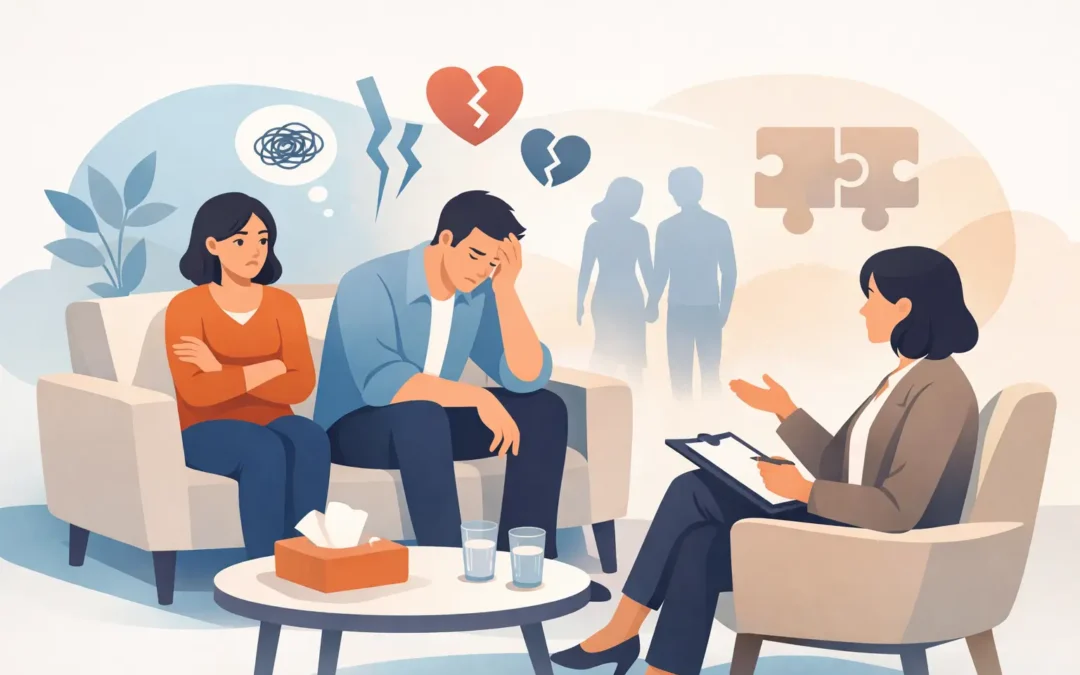
The argument may have ended hours ago, but your body still feels tight. One of you has gone quiet. The other keeps replaying every word. Maybe you are both exhausted by the same fight, the same distance, or the same promise that things will be different next time.
Couples counseling for relationship problems is not about deciding who is right. It is a place to slow down the cycle that keeps pulling you both into hurt, defensiveness, and disconnection – and to understand what is happening before another difficult day becomes another difficult year.
When Relationship Problems Become a Pattern
Most couples do not seek counseling because of one bad conversation. They come because the same problem keeps returning in different forms. You argue about money, parenting, time together, sex, household responsibilities, or a comment that seemed small but landed hard. Underneath the topic, though, there is often a familiar pattern.
One person reaches for reassurance, clarity, or connection. The other feels pressured, criticized, or overwhelmed and pulls away. The more one pursues, the more the other retreats. Soon, both people feel alone in the same relationship.
This can look different from couple to couple. Some partners have loud, intense arguments. Others barely argue at all because they have learned to avoid subjects that might start something. Silence can feel calmer in the moment, but it often leaves disappointment sitting between you at dinner, in the car, or in bed at night.
A relationship can also become organized around resentment. You may keep score without meaning to. You may assume your partner will not understand, so you stop explaining. You may protect yourself by becoming sarcastic, detached, overly busy, or emotionally unavailable. These reactions are understandable. They are also often part of the cycle keeping you stuck.
What Couples Counseling for Relationship Problems Can Address
Counseling gives both of you a structured place to bring the conversations that have become too hard to have at home. The goal is not to force a quick apology or make either person feel blamed. The goal is to see the cycle clearly enough to interrupt it.
You and your therapist may explore what happens just before an argument escalates, what each of you is feeling beneath the anger, and what old experiences may be shaping the way you respond now. Anger may be covering fear of rejection. Withdrawal may be covering a belief that nothing you say will be good enough. Criticism may be carrying loneliness that has gone unspoken for a long time.
This work can help with concerns such as ongoing communication breakdowns, emotional distance, frequent conflict, loss of trust, parenting disagreements, intimacy concerns, major life transitions, and the strain that follows betrayal. It can also help couples who are not in constant conflict but know something important has gone missing.
The details matter. A couple adjusting to a new baby needs something different than a couple rebuilding after an affair. Partners considering separation need a different kind of honesty than partners who feel committed but disconnected. Therapy should not treat every relationship problem as if it has the same solution.
Therapy Is Not About Taking Sides
Many people hesitate to begin because they worry the therapist will decide who is the problem. That fear makes sense, especially if conversations at home already feel like a courtroom. But productive couples work does not revolve around assigning a villain.
It does require accountability. If one partner has been cruel, dishonest, controlling, or repeatedly dismissive, that cannot be brushed aside in the name of keeping things equal. At the same time, accountability is different from shame. The purpose is to understand the impact of harmful behavior, make needed changes, and create conditions where both people can speak honestly.
A therapist can help you move away from arguments that sound like, “You always” and “You never.” That does not mean minimizing pain. It means getting more specific. What happened? What did it mean to you? What did you need? What do you do when that need is not met?
Those questions can feel vulnerable. They are often more useful than winning another argument.
Learning to Interrupt the Moment
Real change is usually built in small moments, not grand speeches. You may learn to recognize the physical signs that a conversation is becoming too heated – a racing heart, a raised voice, a clenched jaw, the urge to leave, or the feeling that you have to prove your point immediately.
Then comes the difficult practice: pausing without abandoning the issue. A pause is not the same as shutting down. It can sound like, “I want to keep talking, but I am too flooded to do it well right now. Can we come back to this at 7:00?” The follow-through matters. Without it, a break can become another form of avoidance.
You may also practice speaking from your own experience rather than making assumptions about your partner’s intent. “When I came home and you did not speak to me, I felt unwanted,” opens a different door than, “You do not care about me.” Neither statement erases the hurt. One gives your partner a clearer chance to understand it.
When Both Partners Are Not Equally Ready
It is common for one person to want counseling sooner than the other. One may feel urgency while the other is skeptical, embarrassed, or convinced that therapy will only make things worse. Do not assume reluctance always means a lack of care. Sometimes it means your partner is afraid of being exposed, blamed, or asked to face pain they have avoided.
Still, waiting forever has a cost. When problems are repeatedly postponed, the emotional gap often gets wider. Partners can become roommates, co-parents, or opponents without noticing how far they have drifted.
If your partner is unsure, it may help to frame counseling as a chance to understand the pattern rather than as proof that they have failed. You are not asking someone to admit they are broken. You are asking them to help look honestly at what is happening between you.
Individual counseling can also be a meaningful starting point when only one partner is willing to begin. You can learn more about your own reactions, boundaries, communication habits, and choices. That work will not control another person’s behavior, but it can help you stop getting pulled so automatically into the same painful dance.
When Couples Counseling May Need a Different Approach
Couples therapy is not the right first step in every situation. If there is ongoing violence, coercive control, intimidation, or fear for someone’s physical safety, joint sessions may not be appropriate. The priority must be safety and support, not improving communication with someone who is using power to cause harm.
Likewise, if there is active substance misuse, repeated deception, or an immediate crisis, the couple may need additional support alongside relationship counseling. A thoughtful therapist can help determine what needs attention first and what kind of care best fits the situation.
Asking for help does not mean you have to know the entire future of your relationship before you begin. Some couples come to rebuild. Some come to decide whether rebuilding is possible. Some need help separating with greater clarity and less damage. Honest counseling makes room for the truth, even when the truth is complicated.
A Different Next Conversation Is Possible
You do not have to keep living on the same fast merry-go-round – tension, argument, withdrawal, temporary peace, then another painful repeat. The cycle may feel automatic now, but automatic does not mean permanent.
At Life Counseling Center, couples counseling is tailored to what is actually happening in your relationship, not a generic script about how couples should behave. The work begins by naming the pattern, understanding where it takes hold, and building practical ways to respond differently when it matters most.
You may not be able to change every hard fact in your relationship overnight. But you can begin with one honest conversation, one clearer boundary, one moment of listening without preparing your defense. Sometimes that is where the path forward starts.
Recent Comments