
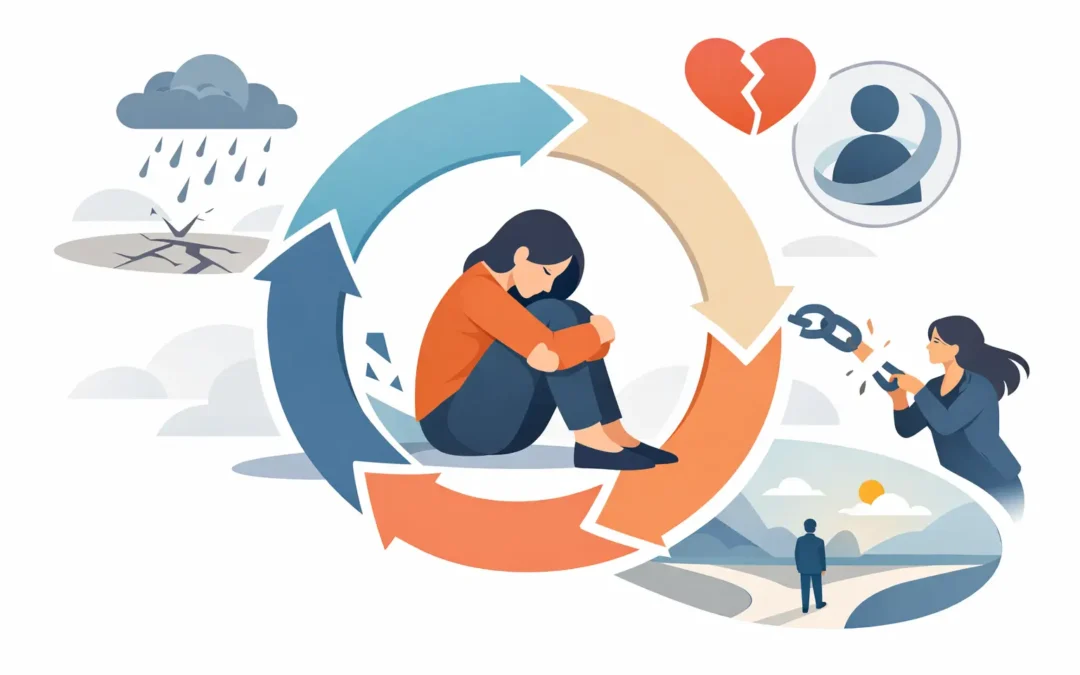
You promised yourself you would handle it differently this time. Then the same thing happened: a hard conversation, a stressful morning, a familiar look from someone you love. Your chest tightened. You shut down, snapped, avoided, overexplained, or reached for something that gives relief for an hour and regret afterward. Learning how to break emotional cycles begins with seeing that these moments are not random failures. They are patterns that have become fast, familiar, and exhausting.
The cycle may look different in your life. Maybe you keep choosing relationships where you feel unseen. Maybe anxiety sends you into overthinking until you cannot make a decision. Maybe conflict at home starts small and ends with everyone hurt and no one feeling heard. You may be tired of saying, “I know better,” while still feeling pulled into the same reaction.
You are not weak because the pattern has lasted. But you do need a different way to meet it.
What an emotional cycle actually looks like
An emotional cycle is a repeated sequence: something happens, you interpret it through past experiences, your body reacts, and you respond in a way that brings short-term protection or relief. Then the result reinforces the same fear, belief, or behavior the next time around.
For example, your partner seems distracted after work. You may immediately think, “They are upset with me” or “I do not matter.” Anxiety rises. Rather than asking what is going on, you withdraw or accuse them of not caring. They become defensive or distant. Now you feel even more certain that you are alone in the relationship.
The problem is not simply that you had a strong feeling. Feelings carry information. The problem is when the feeling takes over so quickly that there is no room to choose your next step.
These cycles often began for understandable reasons. If expressing a need once led to criticism, you may have learned to stay quiet. If unpredictability was part of your childhood, your body may still scan every room for danger. If past rejection hurt deeply, even a delayed text can feel like a warning sign. What protected you at one point may now be keeping you stuck.
How to break emotional cycles: start with the pattern
You cannot interrupt a cycle you only notice after the damage is done. The first real step is slowing the experience down enough to map it.
Think about a recent moment that did not go well. Do not start with blame. Get curious. What happened right before the emotional shift? What did you tell yourself it meant? What did you feel in your body? What did you do next? What happened afterward?
A simple pattern might sound like this: “When I feel ignored, I tell myself I am not important. My stomach drops. I stop replying or become sharp. Then the other person backs away, and I feel more ignored.”
That level of clarity matters. It moves the problem from “This is just who I am” to “This is a sequence I can learn to interrupt.”
Watch for your early warning signs
The body usually recognizes the cycle before the mind has words for it. Your warning signs may be a clenched jaw, pressure behind your eyes, a racing heart, numbness, a sudden urge to leave, or the need to fix everything immediately. For some people, the signal is not intensity but heaviness. You feel tired, distant, and unable to care.
These sensations are not proof that you are in danger or that your worst thought is true. They are signals that your nervous system is activated. If you wait until you are yelling, shutting down completely, or making a decision you cannot take back, the pause will be much harder to find.
When you notice an early sign, name it plainly: “I am getting flooded.” “I feel rejected right now.” “I want to run from this conversation.” Naming the experience creates a small amount of space between you and the reaction.
Separate the trigger from the story
A trigger is what happened. The story is the meaning your mind gave it. Both deserve attention, but they are not the same thing.
Your partner being quiet is a trigger. “They are tired of me” is a story. Your manager asking for revisions is a trigger. “I am going to lose my job because I cannot do anything right” is a story. A teenager slamming a door is a trigger. “I have failed as a parent” is a story.
The story may feel completely convincing, especially when it has been repeated for years. Instead of forcing yourself into fake positivity, ask a more grounded question: “What else could be true?” Maybe your partner is overwhelmed. Maybe the revision request is normal feedback. Maybe your child is struggling and does not yet know how to say it.
This does not mean dismissing real problems. If there is a repeated betrayal, disrespect, or unsafe behavior, you do not need to talk yourself out of your concern. Breaking a cycle sometimes means setting a clearer boundary, having a direct conversation, or making a difficult change. The goal is not to become passive. The goal is to respond from clarity rather than panic.
Practice a pause that is small enough to use
When emotions are high, complicated advice can feel impossible. You need a pause that works in real life.
Try giving yourself 90 seconds before sending the text, raising your voice, making the purchase, or deciding the relationship is over. Put both feet on the floor. Exhale longer than you inhale. Step outside, splash cold water on your hands, or say, “I need ten minutes. I want to come back to this.”
The pause is not avoidance when you return to the issue. It becomes avoidance when you use it to disappear, punish, or delay every hard conversation. A healthy pause has a purpose: regulate first, respond second.
For couples and families, this distinction can change the entire tone of conflict. Instead of continuing until someone says something cruel, agree on a reset plan. Decide how long the break will be and when you will come back. That follow-through builds trust, even when the conversation is hard.
Choose one new response, not a new personality
People often get discouraged because they expect a breakthrough to make every difficult feeling disappear. That is not how change usually works. You may still feel anxious when you speak up. You may still feel angry when a boundary is crossed. The difference is that you begin acting in a way that serves the life and relationships you want.
Choose one response that is specific and realistic. If you tend to withdraw, practice saying, “I am upset, but I do want to talk about this later.” If you tend to explode, practice one sentence that names the feeling without attacking: “I feel dismissed, and I need you to listen before you respond.” If you tend to chase reassurance, wait ten minutes and write down what you need before contacting the other person.
New responses may feel awkward at first. Old patterns feel natural because they are practiced, not because they are always helpful. Repetition is what makes a new path more available when stress hits.
Let the outcome teach you
After you try something different, do not judge the moment only by whether the other person responded perfectly. You cannot control that. Pay attention to what you learned.
Did the pause keep the conflict from escalating? Did naming your need make you feel more honest? Did a boundary reveal something important about the relationship? Did you notice that the emotion rose and fell without you acting on it immediately?
Progress often looks less dramatic than people expect. It may be one fewer angry message. One conversation you return to instead of abandoning. One time you recognize the familiar pull and choose not to follow it. Those moments count because they weaken the belief that the cycle is in charge.
When support can help you get unstuck
Some emotional cycles are difficult to shift alone because they are tied to trauma, grief, depression, anxiety, addiction, family roles, or years of painful relationship experiences. Insight can help, but insight by itself may not change what your body does under pressure.
Therapy gives you a place to slow the pattern down with someone who can help you see what you miss in the moment. Together, you can identify triggers, understand the beliefs beneath them, practice healthier responses, and build goals that fit your actual life. For a couple, that may mean learning to repair after conflict. For a parent, it may mean responding to a child’s behavior without repeating the parenting they experienced. For an adolescent, it may mean finding words for overwhelming emotions before they become isolation or risky choices.
At Life Counseling Center, therapy is built around the cycle you are living in, not a generic script. You do not have to wait until everything falls apart to ask for help. If you feel unsafe, are being harmed, or are thinking about harming yourself or someone else, seek immediate emergency support rather than trying to manage the moment alone.
The next time the familiar pressure starts building, do not demand perfection from yourself. Notice it. Put a name to it. Take one honest pause. A different life rarely begins with one huge decision. Sometimes it begins with the quiet moment when you realize you do not have to keep riding the same merry-go-round.
Recent Comments